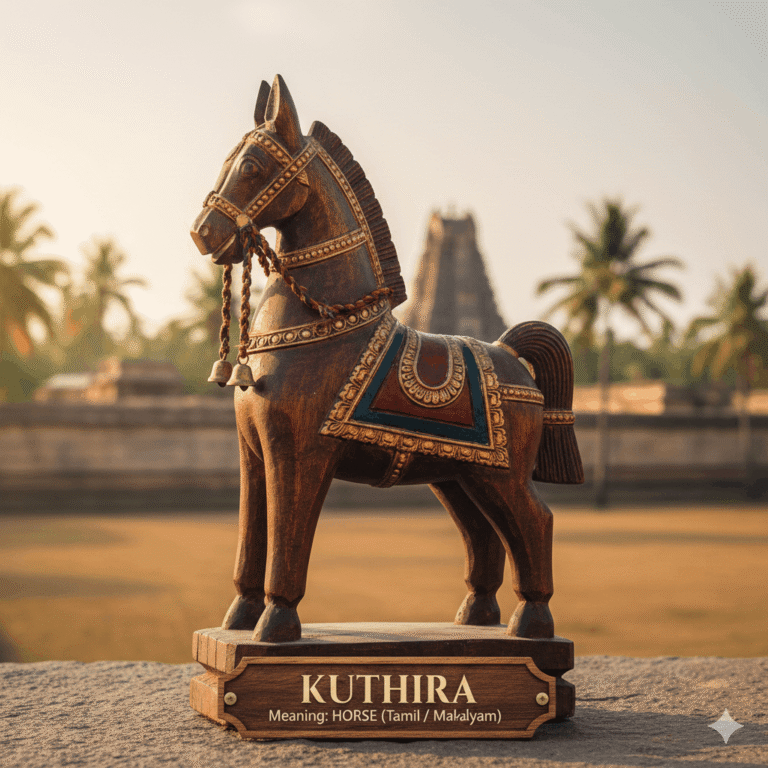
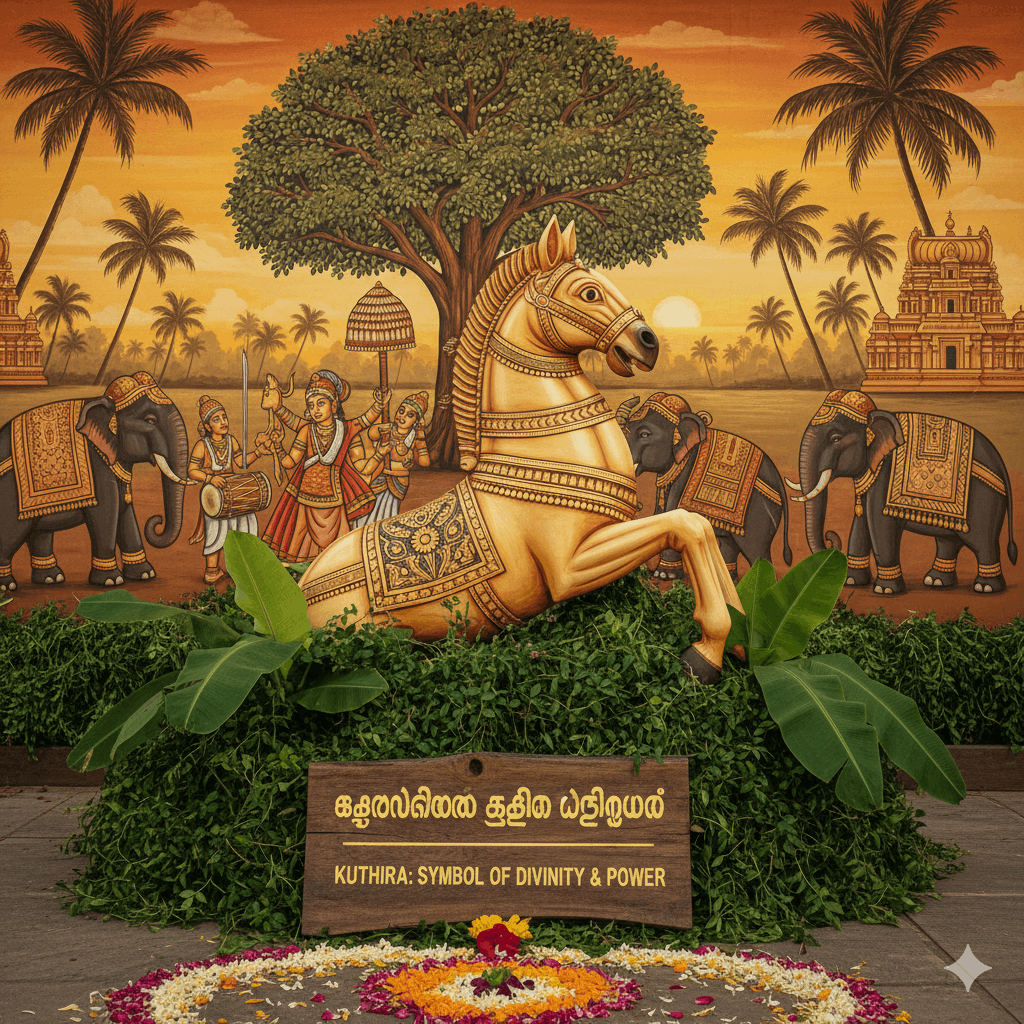
How Kuthira (Horse) Symbolism Shapes Kerala Temple Rituals
Kerala’s temple culture speaks through movement, sound, color, and living symbols. Among those symbols, kuthira (horse) stands out because it sits at the edge between everyday life and sacred meaning. People in Kerala have known horses as signs of speed, travel, status, and protection for centuries. Temple rituals absorbed those ideas and turned them into visible forms you can still see today: in festival processions, in crafted horse figures, in ritual performances, in mural paintings, and in temple carvings.
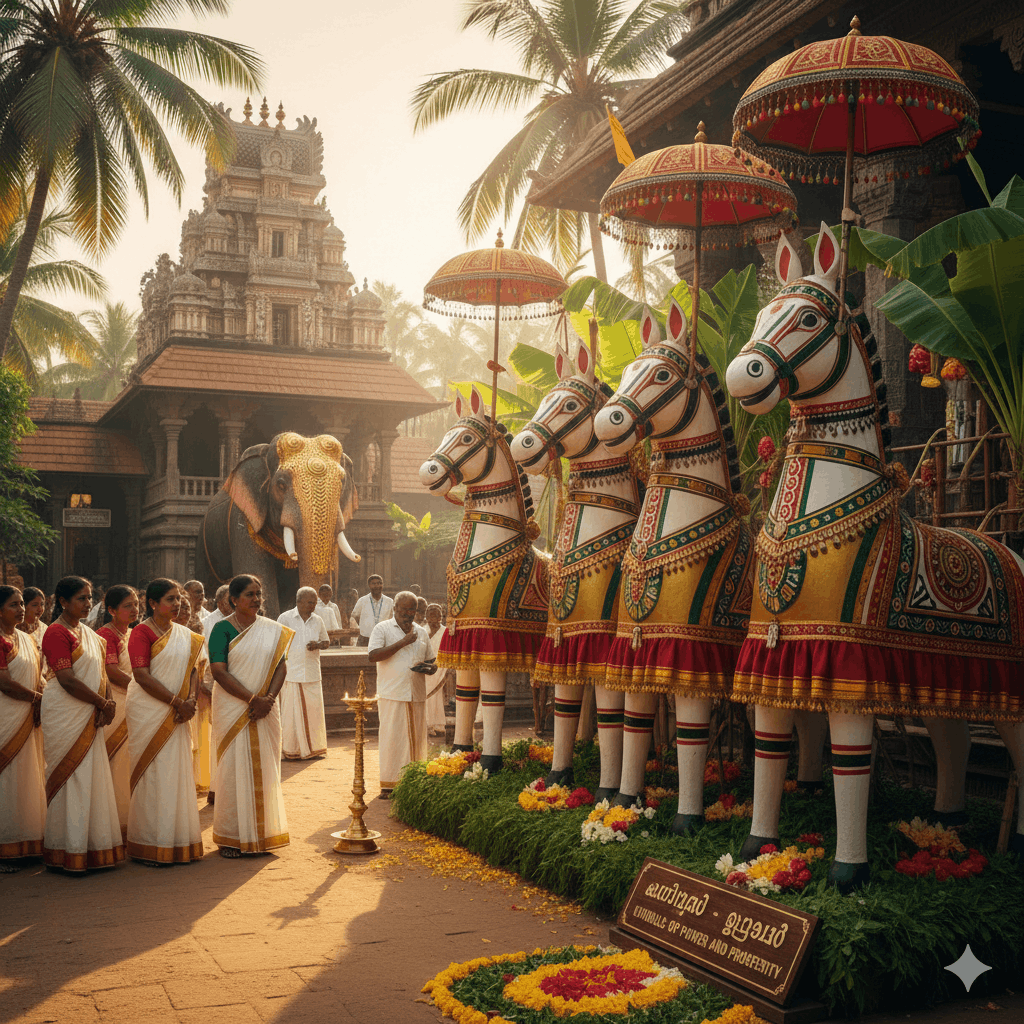
This article explains kuthira symbolism in Kerala in a practical way. It starts with what the horse represents in Kerala culture, then shows how that symbolism appears in temple festivals and folk traditions. You’ll also learn how kuthira meaning in Kerala culture connects with bravery, power, royal memory, and local beliefs, without treating Kerala as one single uniform tradition. Kerala has many ritual styles, and horse symbolism changes from place to place, yet the core themes remain easy to recognize once you know what to look for.
Kuthira symbolism in Kerala: what the horse represents
Kuthira symbolism is not only about the animal. In Malayalam tradition, the horse becomes a shorthand for ideas that are hard to say in a single sentence. In temple contexts, those ideas often include:
- controlled force
- swift movement and urgent intent
- protection of a sacred route
- public honor and community pride
Horse symbolism in Kerala also carries a social layer. In older Kerala society, owning horses or having access to horses could signal status. Even when most people did not own horses, they knew what horses meant: speed, authority, and the ability to move messages or people across distance. Over time, the horse became a cultural symbol that could appear even when live horses were not involved.
Kuthira meaning in Kerala culture and Malayalam tradition
In daily language, kuthira is a simple word. In ritual language, it becomes a sign. When temple life needs to show strength without violence, the horse works well. When a procession needs to show discipline, the horse works well. When a community wants to display unity through shared effort, a horse figure works well because it looks impressive and requires teamwork.
Kerala folk symbolism often uses animals in this way: not as decoration, but as a public sign that the ritual has entered a heightened space where ordinary rules feel slightly different.
Horse symbolism in Kerala temple rituals: why movement matters
Temple rituals are not only stationary prayer. Many Kerala rituals are built around movement: a route, an arrival, a carrying, a circling, a crossing. The horse fits this ritual logic because it is a moving force that people instinctively understand.
When you see kuthira in temple festivals, the symbolism is often tied to one question: how does sacred energy travel through public space?
A procession does not only move an object. It moves attention. It moves sound. It moves the crowd’s focus from ordinary streets to sacred streets. A horse, real or crafted, makes that shift stronger because it pulls the eye and changes the rhythm of the crowd.
Kuthira significance in rituals
Kuthira significance in rituals usually appears in one of these roles:
1) Route and passage
The horse becomes a marker that a route is not casual. The path is part of the ritual.
2) Guarded space
The horse implies order. People make room. The crowd respects distance. That behavior is part of the ritual’s meaning.
3) Public vow and offering
In some regions, ceremonial horses represent a community’s promise, gratitude, or collective devotion.
4) Honor and identity
Some communities treat kuthira-related rituals as a moment of pride that connects present families to older local memory.
Kuthira and bravery symbolism: strength that stays disciplined
Kuthira and bravery symbolism in Kerala is often quiet rather than aggressive. The horse does not need to “fight” to express bravery. It expresses bravery by being powerful and still controlled. That matters in ritual settings because temple festivals demand intensity without chaos.
When people talk about kuthira and power symbolism, they often mean a power that can be guided. A horse that obeys direction becomes an ideal symbol: strong, fast, alert, yet responsive.
This is one reason the horse fits well alongside drum rhythms and procession discipline. The sound may be loud, the crowd may be big, yet the route remains protected and the ritual stays intact.
Kuthira in temple festivals: real horses, ritual horses, and public spectacle
Kerala’s festival landscape includes many formats: pooram festivals with large gatherings, temple anniversaries, local deity celebrations, and folk ritual nights. Kuthira symbolism in Kerala shows up across these formats in different shapes.
Kuthira in pooram festivals
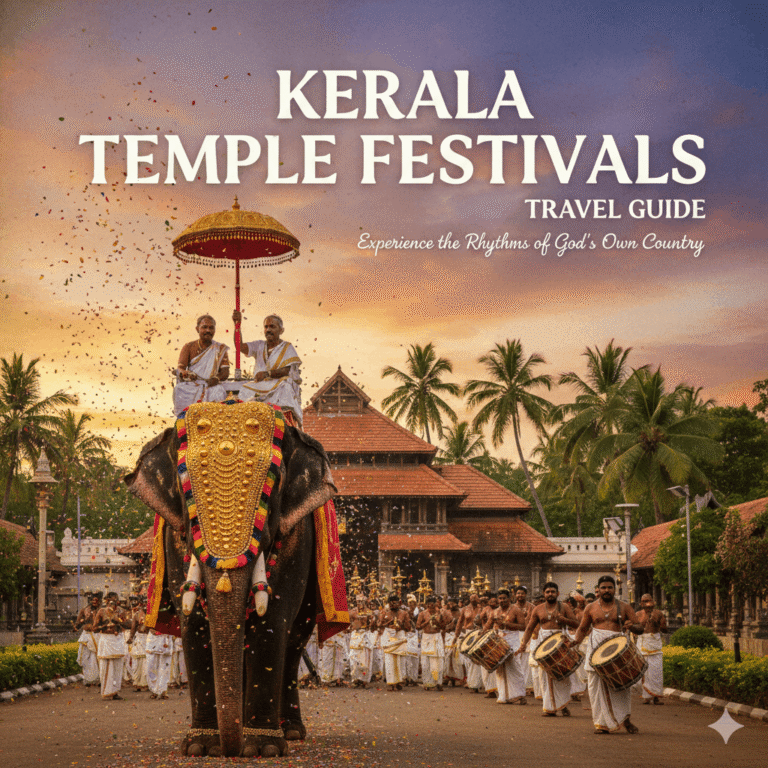
Pooram festivals often involve disciplined routes, large crowds, and intense percussion. Even when a pooram does not feature horses directly, the cultural idea of the horse as a marker of power and movement can still appear through crafted horse figures, banners, or story references. In the public mind, pooram festivals are linked with grandeur and momentum, and kuthira imagery fits naturally into that emotional space.
Kuthira ritual significance in crowd discipline
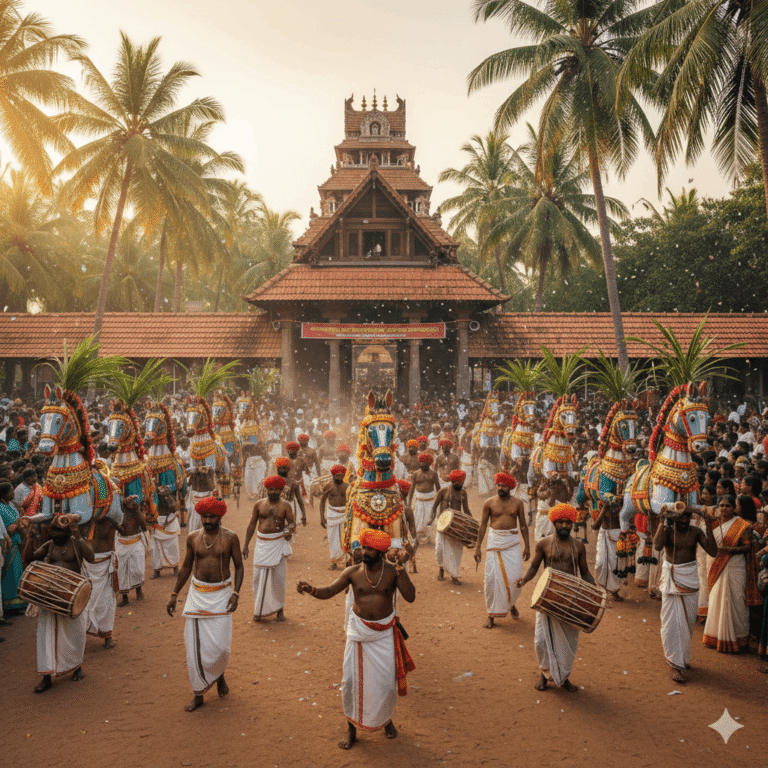
In events where horses are present or where horse forms lead a route, crowd discipline becomes part of ritual meaning. People do not only watch. They participate by giving space, respecting the route, and following local direction. That is why you may see designated guardians or volunteers managing the edges of the route. Their job is not only safety; it also protects the ritual structure.
Kuthira Vela traditions: when the horse becomes the center
One of the easiest places to understand horse symbolism in Kerala is in kuthira vela traditions, where the horse is not a side symbol but the main public focus. These events show how the horse can carry both cultural excitement and ritual seriousness at the same time.
Why kuthira vela feels different
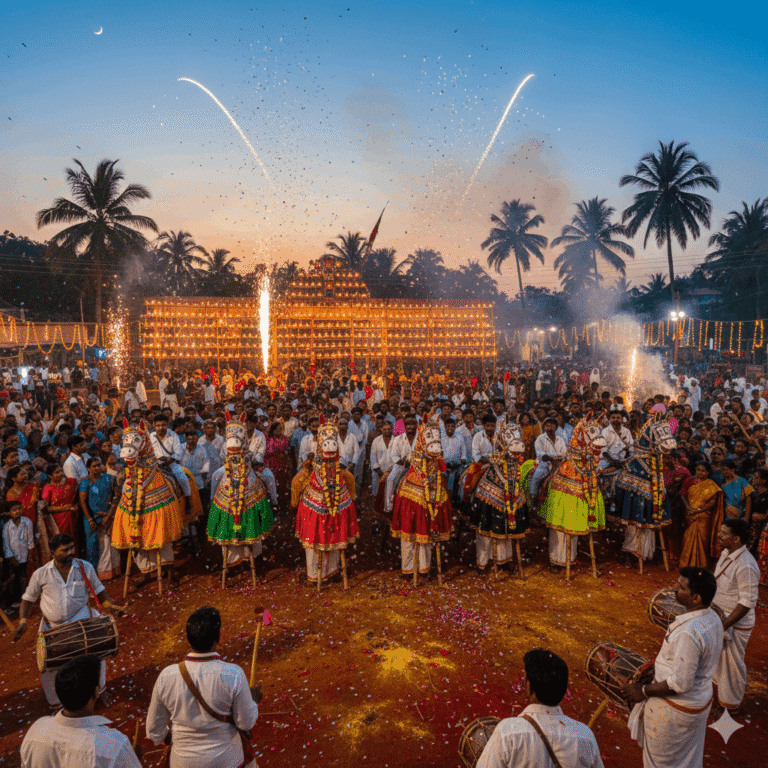
A kuthira vela environment has a strong street-level energy because it is built around movement. The crowd does not wait for a static display. They wait for speed, sound, and a moment that passes quickly. That urgency is part of the ritual feel. The horse becomes a moving sign that something important is happening now, not later.
What kuthira vela reveals about symbolism
Kuthira symbolism in Kerala becomes clearer in such events because you can see it in real time:
- the crowd makes space
- the route becomes sacred space
- the community’s coordination becomes visible
- the horse becomes a sign of public unity and festival power
Even if you are not religious, it is easy to sense that the horse is being treated as more than an animal. It becomes a living symbol the whole crowd responds to.
Ceremonial kuthira offerings: devotion made visible
Kerala has traditions where the horse appears as an offering form rather than a racing or processional element. In such contexts, the horse is not about speed. It is about promise and dedication.
Kuthira as sacred symbolism
Kuthira sacred symbolism often appears in ceremonial offerings because the horse is a “big” symbol. It looks substantial, it signals effort, and it is not casual. When a community builds or presents a ceremonial horse, it publicly shows that devotion required time, teamwork, and shared intention.
Kuthira folk beliefs around offerings
Kuthira folk beliefs may connect the offering to protection, gratitude, fulfillment of a vow, or the hope that a difficult phase will pass. These beliefs are often spoken in simple words at the family level, even when the ritual itself looks grand in public.
Horse representation in Kerala art: murals, carvings, and crafted forms
Horse symbolism in Kerala does not stay limited to outdoor festivals. It also appears in the visual culture tied to temples and royal-era architecture.
Kuthira in mural paintings
Kerala mural paintings often carry mythic scenes, heroic figures, and symbolic animals. When a horse appears in a mural, it frequently signals a transition: a journey, a royal presence, a battle context, or a divine event that involves movement. The horse becomes a tool for storytelling. It helps the viewer understand that the scene is not ordinary life.
Kuthira temple carvings Kerala
Kuthira temple carvings Kerala are another way the symbol stays present. Carvings can show horses as decorative motifs, yet their placement often signals more than decoration: they sit near entrances, roofs, pillars, or structural elements that frame public viewing. In many cultures, animals carved into important architecture represent strength, guardianship, or prestige. In Kerala, the horse can carry these ideas too.
Traditional kuthira art Kerala
Traditional kuthira art Kerala includes crafted horse forms used in folk rituals and festival displays. Some are made with lightweight frameworks and layered materials so they can be carried or displayed for hours. Others are built as large decorative forms in public spaces. Even when the style differs, the message is similar: this is a symbol of force and movement, presented with care.
Kuthira as royal symbol Kerala: memory of authority and travel
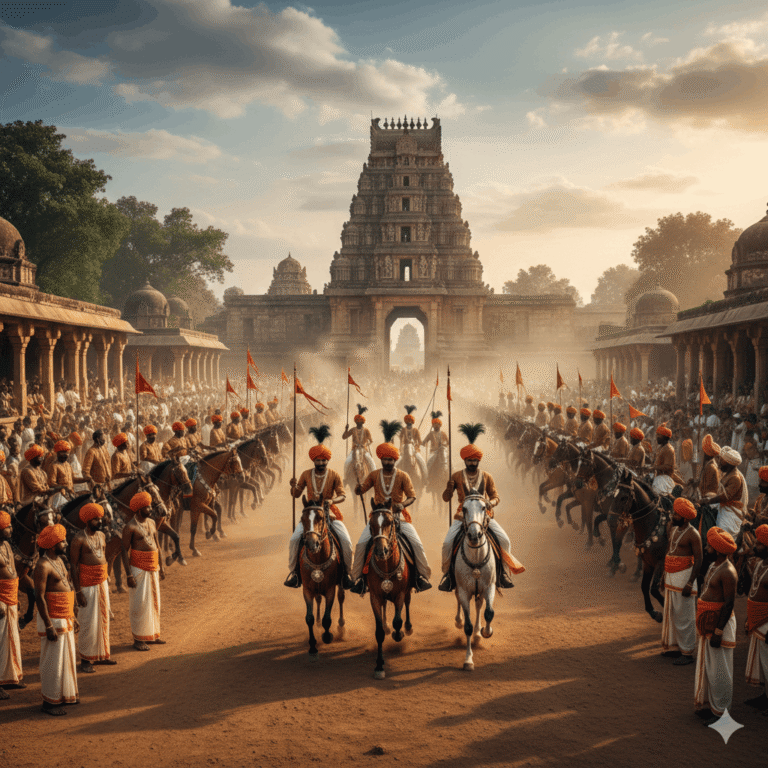
Kuthira in Kerala history is tied to older ideas of governance, travel, and warrior culture. Horses were historically linked with messengers, soldiers, and rulers in many parts of South Asia. Even if local life in Kerala relied more on waterways and foot travel in many areas, the horse still carried a pan-Indian association with authority and martial readiness.
Kuthira in ancient Kerala society and warrior culture
Kuthira and warrior culture Kerala often shows up in stories, oral memory, and visual references. The horse can symbolize readiness, command, and the ability to move quickly. In ritual contexts, these ideas can blend with spiritual meaning: a deity’s power moving through space, or a sacred force “arriving” in public view.
This is also where horse mythological meaning Kerala enters the picture. Mythic storytelling across Indian traditions often uses horses in scenes of travel, battle, divine arrival, and royal duty. In Kerala, those broad mythic patterns mingle with local legends and temple narratives.
Kuthira in Kerala folklore and legends: why the symbol stays alive
Kuthira in Kerala folklore is not one single story. It appears in different shapes across regions. Still, you will notice repeated themes:
- horses as carriers of messages or fate
- horses as signs of a ruler’s presence
- horses linked to testing courage or discipline
- horses connected to protective forces
Horse spiritual meaning Kerala
Horse spiritual meaning Kerala often sits in the “between” space. The horse is not usually worshipped as a deity by itself in mainstream temple settings, yet it becomes part of the sacred language surrounding a deity. It helps express:
- the speed of divine response
- the seriousness of a vow
- the force of a protective presence
These meanings work because people already understand horses as powerful and alert. Ritual meaning grows from familiar ideas, then lifts them into a sacred register.
Kuthira in Theyyam: how symbolism works in ritual performance
The keyword kuthira in Theyyam appears in searches because people associate Theyyam with strong ritual imagery and want to know whether horse symbolism appears there. A careful answer is needed.
Theyyam is not one single performance; it is a wide group of ritual forms in North Kerala with many characters, each with its own costume rules, story patterns, and temple context. Some Theyyam forms use animal imagery strongly. Some do not. So kuthira symbolism in Kerala can intersect with Theyyam in certain locales and character traditions, yet it is not universal across all Theyyam.
How to think about horses in Theyyam contexts
Instead of assuming every Theyyam includes a horse element, it is better to understand the mechanism:
- Theyyam uses visual signs to show power, protection, and story identity
- animal imagery is one tool among many
- the local temple tradition decides what appears and why
If you attend a Theyyam season and want to understand whether a horse symbol is present, watch how the community talks about the character and what the costume is trying to show: guardianship, authority, fury, blessing, or protection. Those themes can overlap with the cultural meaning people attach to kuthira.
Kuthira in Kathakali symbolism: animal imagery and heroic mood
Kathakali is a classical stage tradition with strict visual language. People searching kuthira in kathakali symbolism are often looking for how horses function in Kerala’s performance grammar.
Kathakali storytelling includes royal courts, battles, divine interventions, and journeys. In such scenes, a horse may appear as an implied presence even when not physically shown on stage. In classical narratives, a horse can signal:
- a shift from court to battlefield
- the arrival of a powerful figure
- the urgency of travel
- the status of a warrior or ruler
So the horse works more as a story device than a fixed ritual object in the way it does in temple festival contexts.
Kerala cultural symbols: why the horse stays meaningful today
Kerala cultural symbols survive when they still feel emotionally true. Kuthira symbolism in Kerala remains strong because it matches the lived feeling of festival life: momentum, public coordination, and disciplined intensity.
Even in modern Kerala, where most daily travel happens by bus, car, train, or boat, the horse still carries immediate meaning. When a horse figure appears in a temple festival, people do not need an explanation. They instinctively read it as strength, motion, and honor. That’s why the symbol continues across generations.
How to observe kuthira symbolism respectfully
Seeing horses and horse imagery in temple festivals can be exciting, yet respect keeps the experience safe and meaningful.
Personal space and route discipline
When the crowd is asked to step back, step back. In events involving live horses, the route must remain clear. Even in events with large crafted horses, the carriers need space to move without hitting spectators.
Photography and consent
Photos can be taken responsibly. Avoid stepping into routes. Avoid sudden flash near animals. If you are photographing individuals close-up, ask first when possible.
Families and children
If you attend with children, choose a viewing spot that is slightly away from the tightest edge of the route. You will still see everything, and your day will feel calmer.
Conclusion
Kuthira symbolism in Kerala works because it speaks in a language people already understand. The horse represents power that can be guided, movement that changes public space, and honor that becomes visible in community life. You see horse symbolism in Kerala most clearly in temple festivals, kuthira vela traditions, ceremonial offerings, folk performance worlds, and the visual culture of murals and carvings.
Once you learn the symbol’s core themes, you start noticing it everywhere: in the way a route is protected, in how a crafted horse is carried, in how a crowd makes space, and in how stories of bravery and authority remain present in ritual memory. Kuthira meaning in Kerala culture is not limited to one ritual. It is a thread that connects art, history, folklore, and sacred practice into one shared public language.